Taping a Fitbit to Your Arm Instead of Your Wrist: What Actually Works
Some Fitbit Air users are skipping the wrist strap entirely and taping the device to their arm. Here is what works, what does not, and what it costs.
Why Fitbit Users Are Ditching the Wrist Strap
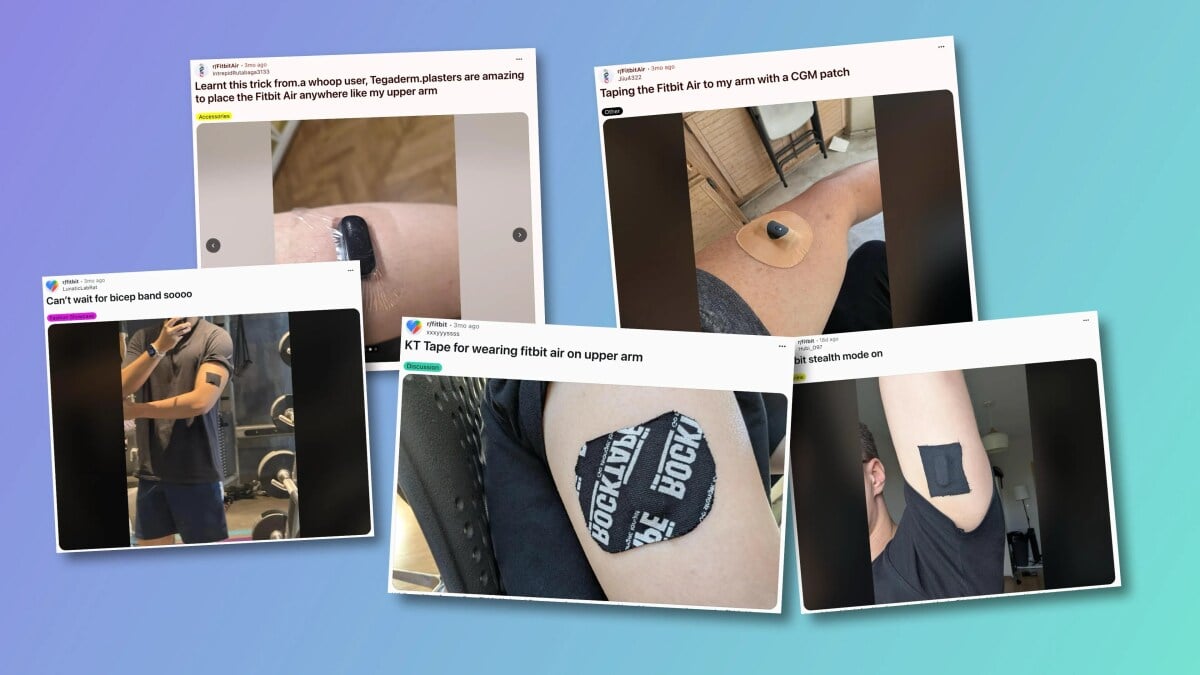
The beauty of a smart band is that it is not a watch and does not need to act like one. That includes where you wear it: Whoop has the right idea with their bicep band and “any-wear” clothing. Since Google has not released a bicep band for the Fitbit Air, some users are taking matters into their own hands - with rolls of tape.
This trend has unfolded on the Fitbit Air subreddit, as one person after another realizes they can just tape the device to their arm, or anywhere they want.
Why Bother Moving It Off Your Wrist
Taping your Fitbit Air to your arm (without the strap, of course) gets it off your wrist. It means the device is no longer in the way of wrist wraps or kettlebells, and you can wear any kind of sleeves or accessories you like without the Fitbit getting in the way or cramping your style. These are minor problems, to be sure. But sometimes, it is nice to just forget you are wearing something.
Which Tape Actually Holds
People are experimenting with different types of adhesives. One of the more popular is KT tape, the stuff that athletes often use to stabilize a body part that is giving them some minor trouble. You can also use athletic or medical tape.
KT tape can start peeling off in just a day if you do a really sweaty workout and then take a shower. Longer strips of tape have plenty of adhesive to keep them on, but a small piece - the size you would need for a Fitbit - is going to have a harder time doing its job.
The best adhesive for the job is probably a CGM overpatch. CGMs, or continuous glucose monitors, are small plastic devices that are typically stuck on the back of the upper arm. A filament pierces the skin to take readings, but to keep it safely in place, the device itself has an adhesive. You can add some security by applying a large sticker called an overpatch. These overpatches are perfect for securing a Fitbit to your arm for long-term use. A typical CGM lasts about two weeks, and the Fitbit Air’s battery lasts about a week. If you want the device to stay on through workouts and showers, an overpatch is more than qualified to do the job.
Does It Actually Work
The Fitbit Air was applied to the back of the upper arm with an overpatch and taken out for a run. It stuck well despite the sweat, and captured heart rate data that matched well with other devices used for comparison.
One risk of taping a Fitbit to your body is that not all areas of the body will capture heart rate equally well. The upper arm may not have great access to blood vessels on everyone’s body (we are all different), but, on the bright side, sticking it under a patch will keep it snug against your skin and block out ambient light. Those factors tend to improve accuracy.
Activity detection may suffer, though. The Fitbit is judging your movement based on what it expects to see your wrist doing in a workout. Your upper arm will not show the same movements as your wrist, so auto-detection might not work properly. When taken out on the road in this configuration, it did not auto-detect a jog. On a second run, starting the workout manually produced better results.
The Downsides to Keep in Mind
Auto-detection of workouts might not work as well, and heart rate accuracy will probably depend on the exact location - and how well it performs may vary from person to person.
There is also the removal problem. An overpatch often has adhesive so strong it is hard to remove at the end of the two-week life of a CGM. If the Fitbit’s battery dies after just a week, you will have to peel off the overpatch at that point to charge it, perhaps painfully and with great difficulty. Removing things like this in the shower helps a lot, as the warm water makes removal easier.
It would also get expensive to apply patches every week. Whether that cost is worth it depends on how strongly you want to avoid a wristband, or whether you only want to do this for a specific occasion.