Why Hyrox Workout Classes Are Worth Trying Even Without Competing
Hyrox-style classes build strength and endurance in one workout. Here's why they're worth your time even if you never race.
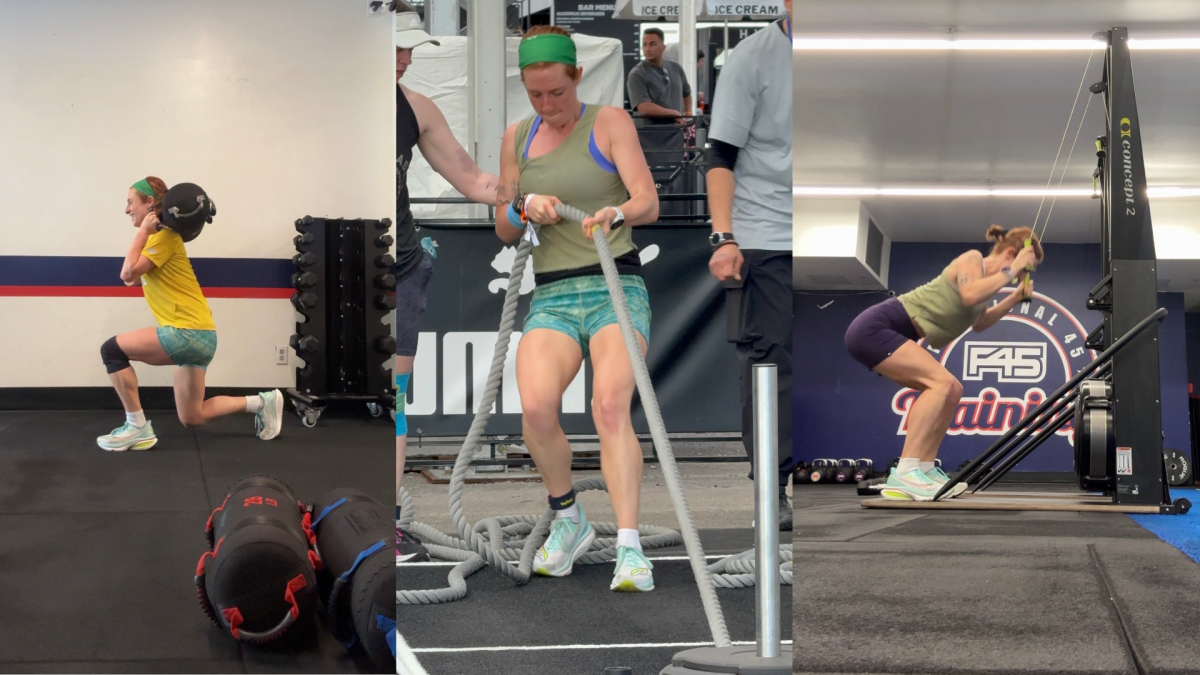

Hyrox is all the rage, but I know that for a lot of gym-goers, it appears to have popped up out of nowhere. Maybe you noticed a class on your gym’s schedule labeled “Hyrox” and wondered what on earth it was. Or maybe a video of an old friend appeared on your Instagram feed with a corny caption about how Hyrox has helped them push their limits. When I first started noticing Hyrox, I felt the same way I have about CrossFit, or Tough Mudders, or any other group fitness trend: a mix of skepticism, indifference, and a vague sense that it simply wasn’t for me.
Now that I’ve completed a Hyrox race, however, I gladly eat my words - or most of them, anyway. (I still think I’d rather run 20 miles than drag a weighted sled across a gym floor for 20 meters.) But even if I never compete in another Hyrox, I’ll definitely be returning to Hyrox-style workout classes. Here’s why I think Hyrox workouts are still worth your time, even if you have zero desire to compete in an official Hyrox race.
What exactly is Hyrox training?
Lifehacker senior health editor (and my doubles partner) Beth Skwarecki goes into more depth elsewhere, but here’s a quick primer on Hyrox: Launched in Germany in 2017, it is currently one of the fastest-growing competitive fitness events in the world. A lot of people will tell you Hyrox is short for “hybrid rockstar,” since “hybrid” is a term that athletes often use when they feel they exist somewhere between the extremes of endurance athletes and strength athletes. The company hasn’t confirmed this origin story, but it fits the bill.
The official race consists of eight one-kilometer runs, each followed by one of eight functional workout stations. It’s clearly designed to be accessible to everyday athletes - not just Olympic-level competitors - which is a big part of why it has caught on so quickly.
But Hyrox training, and the group classes that have sprouted up around it, do not require you to know anything about the race itself. Hyrox-style classes take familiar, functional movements and conditioning principles and repackage them into an intense, coached group workout.
What is included in a Hyrox workout?
The official race’s eight workout stations include the ski erg, sled push, sled pull, burpee broad jumps, rowing, farmers carry, sandbag lunges, and wall balls. In a class setting, you’ll encounter some of these movements, but it really depends on your gym’s resources. And as far as a regular workout goes, the Hyrox framing is a great way to target strength, endurance, and coordination.
In my experience with F45 Hyrox classes, we cycled through intervals or circuits designed to spike your heart rate and challenge your muscles in ways that combine the perks of both traditional cardio and standard strength training - hence the keyword “hybrid.” Classes tend to be around 45 minutes; for context, Beth and I finished our actual Hyrox race in about 97 minutes.
What are the benefits of a Hyrox workout?
Here’s what I can tell you from personal experience: I did five weeks of weekly Hyrox classes at my local F45 gym in preparation for my first race. When I chatted with my fellow gym-goers, I learned I was the only one there with a race on the calendar. Everyone else was there simply because they thought the workout was a good one.
The main selling point of Hyrox training is that “hybrid” branding; your goal is to build aerobic capacity at the same time you’re developing functional strength. For regular gym rats, any class setting is a great way to add structure to your workout, and Hyrox in particular is appealing to anyone craving variety.
As a runner with limited strength training, these classes were crucial to teaching me Hyrox-specific movements before race day (namely sandbag lunges, sled pulls, sled pushes). My coaches broke down the basics in a way that made the movements feel achievable, even for someone with no background in these specific exercises. How “effective” the workout will be depends on a number of factors, but I can tell you that - anecdotally, subjectively, vibes-wise - I definitely feel stronger after my five weeks training for Hyrox.
Is Hyrox considered HIIT or CrossFit?
I’m not surprised by how many people have asked me if Hyrox is just rebranded CrossFit, or if it’s just a glorified HIIT workout. Now that I’ve completed an official Hyrox race, I can tell you that Hyrox is its own thing, while pulling elements from both.
High-intensity interval training, or HIIT, refers broadly to any workout that alternates between intense bursts of effort and recovery periods. Hyrox-style classes often follow this structure, so in that sense the label fits. CrossFit, on the other hand, is a specific branded program with its own community, methodology, and programming. Hyrox shares CrossFit’s emphasis on functional movements and competitive spirit, but the race format is standardized worldwide - every competitor does the same eight stations in the same order - which is a meaningful distinction.
The simplest way to think about it: Hyrox borrows the interval structure of HIIT and the functional-movement focus of CrossFit, then wraps both into a consistent, measurable format. Whether or not you ever toe the start line, that combination makes for a genuinely well-rounded workout.